
Protecting families from contaminated food and water
All fields are required
Protecting families from contaminated food and water
Posted in Our Blog,Outbreaks & Recalls,Salmonella on December 4, 2025
A new Salmonella outbreak has been added to the U.S. Food and Drug Administration (FDA) Active Investigations of Foodborne Illness Outbreaks table yesterday. This one involves a serotype called Salmonella Saintpaul.
What do we know so far about this new Salmonella outbreak? What recent outbreaks have involved this germ recently? Are there any foods we should be looking more closely at? How to know if you are sick with Salmonella?
Follow along for the answers to these pressing questions and more as we navigate this new Salmonella outbreak.
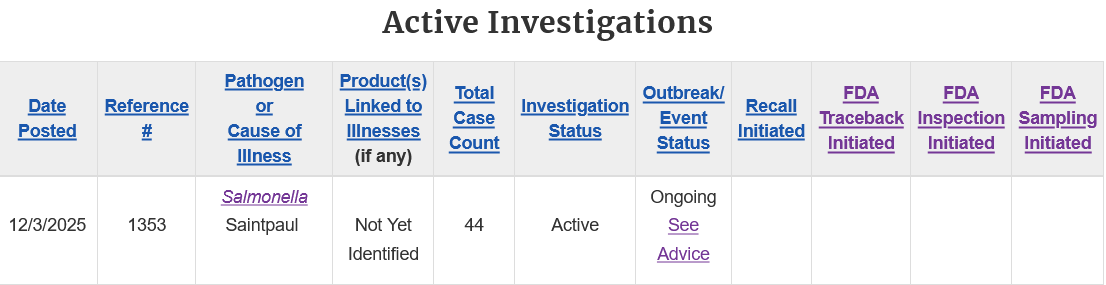
Picture from FDA
A new Salmonella outbreak has been announced and assigned reference number 1353. So far there have been at least 44 cases with this outbreak strain. There is no information available to indicate if there have been any hospitalizations or deaths associated with this outbreak.
The traceback investigation process has just begun for this outbreak and no information is available at this time.
The most recent recall associated with Salmonella involved the serotype Salmonella Richmond and was associated with moringa leaf powder. It is already associated with a foodborne outbreak linked to 11 illnesses and three hospitalizations across seven states.
Prior to that, there was a recall for parsley.
We may be looking at a new food entirely. So, what foods have we seen outbreaks involving Salmonella in the past?
We have seen many outbreaks associated with Salmonella in the past few years.
In 2025 alone there were Salmonella outbreaks linked to Pistachio Cream and Eggs. Cucumbers in May. Mini Pastries in January. Not to mention, the Salmonella Lomalinda outbreak linked to 40 illnesses that was announced in September with no known food source and the Salmonella Enteritidis outbreak announced in August linked to 45 illnesses with no known food source.
In 2024 we saw Salmonella outbreaks associated with cucumbers in November, eggs again in September, more cucumbers in June, and basil in April.
2023 brought Salmonella outbreaks associated with cantaloupes in November, onions in October, raw cookie dough in May, and flour in April.
Besides these known sources, a number of other foods are commonly associated with Salmonella bacteria.
FDA, state, and local health departments and investigators are still investigating this outbreak. Until specific food are identified and recalls are announced, there is no reason to avoid any particular food. To keep your family safe, you can always pay closer attention to food safety practices involving some higher risk foods for Salmonella.
What types of food are we talking about?
Eggs and Salmonella. I am sure you have heard that connection before. With a Salmonella outbreak going around, it is good time to make sure you are preparing egg dishes safely.
Eggs are often contaminated before the shell is formed around the white and yolk, making them a higher risk food to consume raw or undercooked. Always fully cook eggs and opt for pasteurized versions for recipes where like homemade mayonnaise or hollandaise sauce where eggs are used raw.
Salmonella and chicken are commonly associated with each other. Which came first though? The chicken or the egg. Better to be safe and use caution with both.
Chicken isn’t the only raw meat associated with Salmonella though. Other raw meats are vulnerable to this germ too!
How does it happen?
Raw meat and poultry can become contaminated with fecal matter during the butchering process, leading to gross contamination. But seafood is vulnerable as well. Especially if it harvested from contaminated water.
Unpasteurized (raw) milk and milk products may be contaminated with Salmonella. Milk can become contaminated in the same way meat can become contaminated. Even trace amounts of fecal matter can contaminate a batch of milk.
Unpasteurized dairy products have not undergone a heat treatment process designed to kill those harmful germs. Leaving consumers vulnerable to Salmonella infections. Campylobacter, E. coli, and Listeria are also causes for concern with unpasteurized dairy products.
Select pasteurized milk and dairy products to reduce your risk.
Even fruits and vegetables can be the bearer of Salmonella and cause outbreaks.
In some cases, fruits and vegetables are irrigated with contaminated water. This can happen when surface water is contaminated prior to use or wastewater is not sufficiently treated to kill harmful pathogens.
If not contaminated in the field, fruits and vegetables can also be contaminated at any point in the supply chain. Or even once you get them in your possession. Cross contamination from meat or other foods that could contain Salmonella could lead to contaminated fruits and vegetables.
This is especially concerning when these foods are eaten raw.
Salmonella bacteria are microscopic germs that can cause illness in humans and animals. Most often, this microorganism is associated with food or contaminated water.
Around 1.35 million cases of Salmonella illness occur in the United States each year, making it a leading cause of foodborne illness in the country.
Unfortunately, only a fraction of Salmonella infections are diagnosed. The CDC estimates that only 1 in every 30 infections are reported.
Have you become sick with a digestive illness recently? You may be wondering if you have a Salmonella infection.
Only specialized laboratory tests can confirm Salmonella infections. If you are diagnosed with this illness, your sample will be compared to the outbreak strain. If it is a genetic match, your illness will be added to the outbreak table.
See your healthcare provider or report your illness if you experience symptoms associated with Salmonella illness.
Symptoms may include diarrhea, fever, and stomach cramps, often beginning somewhere between 6 hours to 6 days after exposure. Illness typically lasts around 4 to 7 days.
For most, medical intervention is not necessary. However, some people may experience complications requiring a trip to the doctor’s office. Some infections are so severe, sick patients require hospitalization.
Call a doctor if you have:
Dehydration is a serious issue with illnesses involving diarrhea and vomiting.
Salmonella infections should be taken very seriously. Serious, life-threatening complications may develop.
If you have become sick with Salmonella recently, you may be part of a larger Salmonella outbreak.
This type of illness can take a toll. Both on the body and the bank account. Medical bills, missed work, the stress of caring for a sick loved one, and other burdens associated with foodborne illness add up.
If you wish to make a legal claim, The Lange Law Firm, PLLC has a Salmonella lawyer that can help.
The Lange Law Firm, PLLC has successfully represented cases just like yours and won millions of dollars in food poisoning and products liabilities lawsuits.
Reach out by calling (833) 330-3663 or send us an email for a free, no obligation consultation.
By: Heather Van Tassell (contributing writer, non-lawyer)