
Protecting families from contaminated food and water
All fields are required
Protecting families from contaminated food and water
Posted in Food Policy,Our Blog,Raw Milk on March 30, 2026
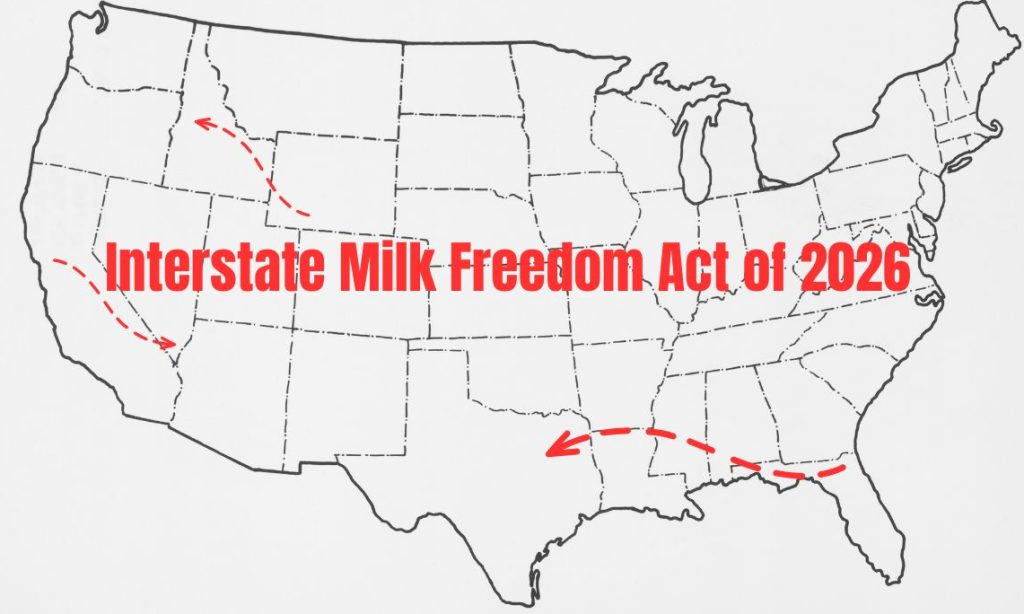
The Interstate Milk Freedom Act was re-introduced earlier this month by Representative Thomas Massie of Kentucky. An identical version of this proposed act was submitted in 2024 by the same representative. If passed, this act would ban Federal interference of the sale of raw milk across state lines.
Currently, raw milk is the only food product with that restriction.
There are, however, some rules which sellers must comply with.
What is the proposed Interstate Milk Freedom Act of 2026? Why are people for the Act? Why are others against it? What is so controversial about raw milk?
Let’s dive into the Interstate Milk Freedom Act and what it means for the public!
Introduced by Rep. Thomas Massie (R) of Kentucky and co-sponsored by Rep. Chellie Pingree (D-ME), Rep. Warren Davidson (R-OH), Rep. Glenn Grothman (R-WI), Rep. Clay Higgins (R-LA), Rep. Scott Perry (R-PA), Rep. Chip Roy (R-TX), Rep. Lloyd Smucker (R-PA), Rep. Lauren Boebert (R-CO), and Rep. Nancy Mace (R-SC) on March 9, 2026, the Interstate Milk Freedom Act of 2026 would allow raw milk sales across state lines.
According to the Act, currently H.R.7880, the Interstate Milk Freedom Act of 2026 is:
“To prohibit Federal interference with interstate traffic of unpasteurized milk and milk products that are packaged for direct human consumption.”
But that doesn’t mean that they can sell their milk anywhere. There are some reasonable rules that go along with this act.
Whether by retail sale, direct farm to consumer distribution, or cow share, the seller must originate from a state that allows “by law, regulation, or policy” the sale of these unpasteurized products.
This ensures that the originating seller complies with their own state or local regulations in handling and selling these products.
The Act also ensures certain compliance. Even if requirements may vary from jurisdiction to jurisdiction. This at least ensures activities such as producing, packaging, labeling, warning, and any other requirements of the originating jurisdiction are met.
Finally, raw milk can only be transported to states who already allow raw milk. Not just allow raw milk, but a very specific conditions of allowing raw milk for direct human consumption.
For example, some states allow raw milk sales for animal consumption only.
The applicable laws of the receiving state or jurisdiction, on the other hand, do not need to be identical to the laws and policies of the state of origin. So, there is still some flexibility for buyers and sellers.
Every few years this bill or something similar to it comes up. Some states of made the sale of raw milk within their borders completely illegal. Others have specific limitations and/or rules in place. All indicate public concern for safety of raw milk to their citizens.
So, exactly are people for this Interstate Milk Freedom Act?
One of the most obvious reasons a raw milk dairy would want to transport their unpasteurized product across state lines is to widen their customer base. In rural areas, especially those on the border, having a wider audience could be beneficial.
Potential customers who are a hop across the border may be closer than residents of their own state counties over.
In an already struggling industry, widening the customer base could greatly impact the viability of a dairy farm.
Then there are the nay-sayers. The folks opposed to the Interstate Milk Freedom Act of 2026. Their reason is the same reason they are against raw milk and raw milk products in general.
Safety.
In addition to being opposed to the product due to inherent risks of contamination and spread of illness from the unpasteurized product, travel increases the time for harmful germs to reproduce.
The longer milk goes from animal to consumption, the longer it has to grow small numbers of bacteria into infectious quantities.
Transporting unpasteurized milk and unpasteurized milk products, even under refrigerated conditions, is one of the major talking points of those opposed to the Interstate Milk Freedom Act of 2026.
Why is raw milk so controversial anyway?
Let’s start by understanding what is mean by “raw milk.”
Raw milk is a term used for milk that has not been pasteurized. Referred to in the Interstate Milk Freedom Act as “unpasteurized milk.”
It has not undergone heat treatment through a process that kills potential illness-causing germs often associated with dairy products.
The term applies to any milk. Whether from cows, sheep, or goats.
Pasteurization is a widely used process invented in 1864, by the namesake inventor, Louis Pasteur. Pasteur discovered a way to heat treat beverages in order to kill harmful microorganisms. Microorganisms responsible for diseases such as listeriosis, typhoid fever, tuberculosis, diphtheria, Q fever, and brucellosis. Among others.
The original intent for pasteurization was to help increase the shelf life and reduce spoilage of beer, wine, and other beverages. As you can imagine, a pressing issue of the time. Today, it is most commonly associated with milk. Though juices and certain shelf stable foods are also commonly pasteurized. Many illnesses prior to pasteurization were linked to milk and dairy products. A problem that has almost entirely been eradicated since widespread use of pasteurization.
Since the mainstream application of pasteurization, the number of milk-related outbreaks has decreased from 25% to only 1%. With 70% of those outbreaks involving raw milk.
Raw milk is risky because without the heat treatment of pasteurization, potential germs found on dairy farms can make their way into the milk and sicken the consumer.
Over the years, several illnesses have been associated with unpasteurized milk.
The Interstate Milk Freedom Act of 2026 is the most recent attempt at expanding raw milk sales on the national level. Standalone bills like this one were introduced in 2014, 2015, 2019, 2021, and 2024. It was also included in the 2018 Farm Bill.
Each time, the act has stalled.
Only time, and persistent legislators, will determine if the Act comes to fruition.
If you’d like to know more about food safety topics in the news, like “Interstate Milk Freedom Act Would Ban Federal Interference in Raw Milk Sales Across State Lines,” check out the Make Food Safe Blog. We regularly update trending topics, foodborne infections in the news, recalls, and more! Stay tuned for quality information to help keep your family safe, while The Lange Law Firm, PLLC strives to Make Food Safe!
By: Heather Van Tassell (contributing writer, non-lawyer)