
Protecting families from contaminated food and water
All fields are required
Protecting families from contaminated food and water
Posted in E. coli,Our Blog,Outbreaks & Recalls,Raw Milk on February 25, 2026
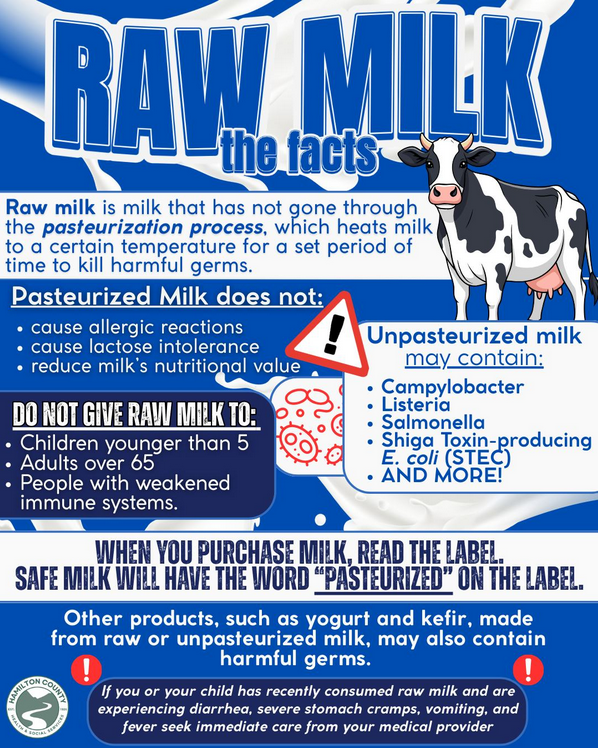
County health officials are warning the public of an uptick in E. coli infections linked to raw milk in Hamilton County, Tennessee.
Public Safety announcements on the topic have been distributed on social media to spread awareness on the serious, even life-threatening illness associated with the risky product.
Is raw milk legal in Tennessee? Why is raw milk risky? What should you do if you get sick? Follow along to find out!
But first, here’s what we know so far about illnesses associated with raw milk in Hamilton County.
A recent notice from the Hamilton County Health Department warns residents of an “unexpected increase in Shiga toxin-producing E. coli (STEC) cases in 2026 associated with the consumption of raw (unpasteurized) milk.”
It is unclear how many reported illnesses have been received by the county. But it is enough to warrant a public notice about the risky food.
Raw milk is not legal in all states. Certain laws limit the sale of raw milk in Hamilton County and the state of Tennessee. But it is not completely illegal.
Raw milk is only legal through what is known as a herdshare. It is essentially an agreement of ownership with a farmer. Members of the herdshare pay a specified amount to the dairy farmer to manage and milk the cow in exchange for a “share” of the milk produced. However, that milk is only allowed for personal use and cannot be used in restaurant or food service applications.
The 2020 Tennessee House Bill 1129 and Senate Bill 1123 outlines the requirements for a herdshare in the state of Tennessee. Lists of all members and contact information must be retained for at least three years and a written herdshare agreement is required between the member and farmer outlining the terms and rights of the herdshare situation.
Raw better sold by producers with a dairy plant permit is also allowed. But only from producers with a dairy plant permit. Raw milk for pet use is also legal. However, a commercial feed permit is necessary.
Despite the risks and hurdles, raw milk is surprisingly available in Hamilton County.
A brief Internet search uncovered 16 farms offering direct sales and 20 retail locations (including stores, drop points, and delivery services) where raw cow’s milk is available.
To understand why raw milk is risky, you must first consider where these germs come from.
Bacteria that can cause serious human illness are commonly found in the digestive system of healthy cows. The bathroom habits of cows, as you can imagine, are not as clean as those of most humans. There is no toilet paper. There is no designated space. Not to mention the fact that their udders are dangerously close to that area of the body.
It also does not take much of these harmful germs to contaminate whole batches of milk.
That is why pasteurization has become mainstream in modern society.
Pasteurization is a heat treatment process that brings the milk to a high enough temperature to kill potential bacteria that have inadvertently made their way into the milk.
Raw milk does not undergo this heat treatment. Leaving it vulnerable to contamination and subsequent illnesses like the situation involving E. coli and raw milk in Hamilton County.
But E. coli isn’t the only risk for raw milk.
There are several other germs commonly associated with raw milk that can cause preventable illnesses and diseases.
Other illnesses caused by raw milk pathogens may include:
The symptoms of E. coli infections can vary from mild to severe. Most people begin feeling sick around three to four days after exposure.
Symptoms to look out for include:
Normally healthy people generally recover from E. coli infection within five to seven days. Some people, on the other hand, may experience other complications. These complications may lead to hospitalization or even death.
The elderly, young children (under five years), and those with a weakened immune system may experience more severe illness or develop serious complications. Complications like hemolytic uremic syndrome, or HUS.
HUS, is a rare, but serious health condition that can develop after becoming sick with a toxin-producing bacteria like E. coli.
This complication develops when toxins rupture blood cells. These ruptured bloods cells clog the filtering aspects of the kidney. This can result in kidney failure and cause other downstream negative health effects.
People with HUS require hospitalization and monitoring to prevent further damage.
Symptoms to look out for include decreased urination, paleness in cheeks and inside of lower eyelids, and fatigue.
If you have been sick with symptoms consistent with E. coli infection and begin experiencing these HUS symptoms, get medical help right away!
Hamilton County Health Department warns that “raw milk can carry harmful bacteria that may cause severe or life-threatening illness, particularly in young children, older adults, pregnant individuals, and individuals with weakened immune system.
If you have recently consumed raw milk in Hamilton County, there are a few things you should do.
If you have consumed potentially contaminated raw milk, you may become sick. In some cases, it could take a week or more for symptoms to appear. Seek medical attention if you become sick. Even if you are not severely ill. Your sample may be linked to a potential outbreak investigation.
If you still have it, retain packaging and receipts if possible. Your purchase may help investigators narrow or widen the scope of the investigation. Your assistance may be able to help prevent others from becoming sick.
Hamilton County Health Department urges the community to report their illness.
“Timely reporting helps protect others in our community. Please monitor official updates from the Hamilton Conty Health Department for additional guidance.”
Finally, reach out to an E. coli lawyer. Salmonellosis can cause serious illness and loss. An E. coli lawyer can help answer questions, investigate your illness, and file a claim to recover the financial burden associated with your illness.
The Lange Law Firm, PLLC has recovered millions of dollars for families with cases just like yours. With a specialty in contamination, products liability, and food safety cases, you can trust the E. coli and Raw Milk Lawyers of The Lange Law Firm, PLLC to navigate this complicated legal process on your behalf.
They know the questions to ask, the information to obtain, and how to build your case. Their compassionate team will help you through this unfortunate situation and get you the justice you deserve.
Don’t wait! Contact The Lange Law Firm, PLLC today!
Call (833) 330-3663 or click here to fill out an online submission form to get started today with a free consultation.
By: Heather Van Tassell (contributing writer, non-lawyer)